"Marty Supreme" Review: Timothée Chalamet Excels In Josh Safdie's Explosive Ping-Pong Epic
I got to see "Marty Supreme" a few days early. It is a magnetic film that you cannot look away from, nor will you want to look away from it.

“A film about table tennis? How could that possibly be any good?”
I’d wager that more than a few people have asked those questions since seeing the first trailers for Marty Supreme, the latest leading effort from Timothée Chalamet. The film, directed by Good Time and Uncut Gems co-director Josh Safdie in his solo directorial debut, and produced by independent film auteurs A24, is unconventional in that regard. Sure, we’ve had plenty of sports films. But table tennis? Really?
Through sheer force of will, the answer to that question is “yes.” The answer to the question at the very top is “because it’s electric.”
For two and a half hours, Chalamet, alongside co-stars Odessa A’zion, Gwyneth Paltrow, Tyler Okonma (best known as superstar musician Tyler, the Creator), and Kevin O’Leary, leaves you on the edge of your seat as everyone makes some appallingly bad decisions. Through it all, the question that continues to persist is: “How do they all get out of this?”
The film is set largely in early 1950s New York. But, trips to the United Kingdom and Japan quickly remind us of the specter of World War II that continues to affect the lives of these characters.
Because of that postwar setting, it would be easy to view Marty Supreme through a more patriotic lens. Marty Mauser, who was the top-ranked American table tennis player at the time of the British Open, loses handily to a Japanese man named Keto Endo, who then returns to his home country as a hero for being the first athlete from Japan to win a major tournament since the end of the war. The rest of the film sees Marty obsessing over the idea of proving that his first loss to Endo was a fluke, doing whatever is necessary to get to Japan to prove himself right.
There’s unquestionably some of that, as sleazy businessman Milton Rockwell, played by the aforementioned O’Leary, lost his son in the war. Marty’s friendly rival, Bela Kletzki (Géza Röhrig), is a survivor of Nazi rule. Marty himself references by saying that by beating Kletzki, he’ll “do what Auschwitz couldn’t.” When Rockwell and Kletzki meet, Rockwell says his son died “liberating” Jewish prisoners, to which Marty snarkily credits the Soviets instead. When Endo qualified for the British Open, several people questioned how, since travel restrictions from the end of the war should have disqualified him from competing.
Still, Marty Supreme feels like a film about raw ambition (or selfishness, more accurately) much more than it feels like a film trying to make a hard political statement. Marty has a Michael Jordan-like obsessiveness with being the absolute best in his sport, and he views the loss to Endo as an insult to his entire being. Chalamet has spoken at length about his desire to be viewed as one of the greatest actors of all time, and his own obsessive nature feels as if it guides what is ultimately a stellar leading performance. I hesitate to call it his greatest showing to date, but it is unquestionably one worthy of award consideration.
Speaking of the aforementioned O’Leary, the quality of his performance is shockingly good for someone whose entire filmography consists of… just this film. Rockwell is a slimy multi-millionaire who initially pitches Marty on a scripted rematch against Endo for an event in Japan to help promote his ink business. Marty rebuffs him and disrespects him and his son on multiple occasions, but when he’s left with no way to get back to Japan for the tournament happening within the same week as the event, he is forced to grovel.
Rockwell takes joy in humiliating Marty, and paddles him in front of several of his millionaire friends at the conclusion of wife Kay Stone’s (Gwyneth Paltrow) “return to acting” party. He brings Marty to Japan, but does not take him back after Marty demands a non-scripted match against Endo and beats him.
Far be it from me to defend the millionaire against the broke athlete trying to cement his place in history, but Marty is a selfish and petulant character for much of the film. His selfishness affects so much of the world around him. And that is by design, as by the end, you can’t help but root for him despite his warts and one-track worldview.
Marty hooks up with childhood friend-turned-lover(?) Rachel Mizler (Odessa A’zion), who gets pregnant barely ten minutes into the film, complete with a scene depicting a sperm racing to an egg, inexplicably set to Alphaville’s “Forever Young,” a song released some three decades after this film takes place. At the end of the film, after Marty finds himself tied up with more than a few criminals on the hunt for their missing dog Moses, he almost gets Rachel (who is now eight months pregnant) killed by an errant gunshot from the man who took Moses in.
Wally, the affable taxi driver played by Tyler Okonma, is left jaded and with much less money than he started with after he and Marty first recover Moses following an unfortunate series of events that concludes with Marty falling through the ceiling of a rundown hotel. Wally has kids, and the hunt for the dog prevents him from taking fares that could help his family out. When he and Marty scam a group of people out of hundreds of dollars in table tennis matches, Marty takes the full sum for himself and leaves Wally to fend for himself to try recouping his losses.
Wally is the exact character needed to serve as Marty’s other half, as he’s a person with real responsibilities and other people to think about before making his moves. Okonma plays him very well, and it would be fun to see him get more acting opportunities. But needless to say, Rockwell paddling Marty is maybe the lightest punishment he could have walked away with.
Of course, despite Chalamet’s leading performance and both O’Leary and Okonma delivering in their roles, the film would not sing nearly as loudly without the performances from Gwyneth Paltrow and Odessa A’zion. Paltrow plays washed-up actress Kay Stone, who attempts an acting comeback in a play fully funded by her husband.
She also begins a sexual relationship with Marty, as we quickly learn that Rockwell and Stone’s own union is a loveless one. Marty and Stone’s relationship comes to a head when they nearly get arrested for having sex in Central Park on the opening night of Stone’s play. The play receives a negative review, and after that, she is no longer a factor in the film. But while she is involved, she shines as the exact opposite of Marty. Stone is older and much more of a realist, while Marty’s bullheaded optimism and faith that everything will work out eventually become a point of contention that shows just how far apart they truly are. Paltrow is wonderful as the cynical character, and she and Chalamet display some near-perfect chemistry in the scenes they occupy together.
Odessa A’zion delivers a similarly strong performance as Rachel once Marty comes back to New York after his lengthy worldwide trip. The pair have their Bonnie & Clyde moment on the aforementioned search for Moses that ends with her getting shot in a rural part of New Jersey. Upon returning to the city, she gets surgery and, not long after that, has their baby.
Most importantly for the narrative surrounding their relationship, Rachel is married to another man, so her entire dynamic with Marty can most generously be described as an affair. Rachel is deeply flawed and has a manipulative streak to her, as she fakes being abused by her real husband as part of her effort to get Marty to be with her. However, she is also scared and desperate for much of the film. She knows the child she’s carrying is not her husband’s, and that information becoming public would end another loveless, but safe, marriage.
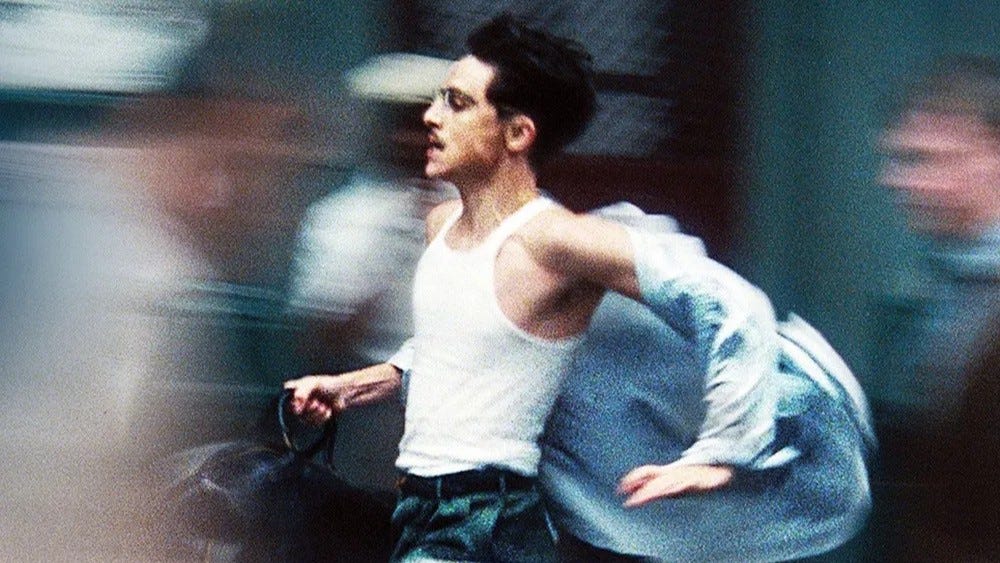
However, after a nerve-wracking two and a half hours, where everyone involved makes fundamentally poor choices (I failed to mention it earlier, but Marty only got to Britain because he robbed one of his uncle’s employees at gunpoint for $700, and he then spends a section of the film running from the NYPD in a section that reminds us all that a Safdie brother did in fact direct this) and several people die, Marty Supreme ends on a surprisingly hopeful note. Rachel has the baby about a month early, but there are no complications.
Marty returns home from Japan on an army plane, as the soldiers who attended the Rockwell event took a liking to Marty after he beat Endo and decided to help him get home. He rushes to the hospital and showers Rachel with love before meeting his new son, which causes him to break down. Obviously, beating Endo was vindicating for him, but it’s clear that becoming a father did more to change him than any amount of “revenge” could.
Marty Supreme is many things. It’s an out-there sports film about a sport that’s never been taken seriously in the United States. It’s also a commentary on the world in the first few years after one of the most world-altering events in human history, with pro-USA undertones that are not nonexistent, but also not central to the story. Perhaps most importantly, it’s the story of an ambitious man with a deep belief in himself and a similar shallow understanding of how reality works, told at a breakneck pace with very few moments of reprieve from the first frame to the end.
It could have easily buckled under the weight of its own extended runtime. However, under Safdie’s direction, Chalamet and the rest of a remarkably star-studded cast help turn it into one of the best films of the year.
Rating: 4.5/5